
Refund policy
Refund policy
If you run an ecommerce store, or you sell goods and services to customers, you need to draft a Refund Policy and publish it on your website either as a standalone document or as part of your Terms and Conditions agreement. This is the only way to ensure that customers understand their rights before they make a purchase from you.
Having a clear Refund Policy can instantly make your store seem more attractive and professional, which encourages customers to shop with you. Think of it from a consumer's perspective - if you don't know what a store's Refund Policy is, would you really buy goods or services from them?
Even if you don't offer refunds, customers still have a right to know what your position is. So, every ecommerce store, or website selling goods and/or services, should have at least a few clauses on refunds.
Before we consider what to include in your Refund Policy, let's take a closer look at what a refund policy is, and why they're a good idea.
Get compliant today with PrivacyPolicies.com
Select one of our generators to create the required legal agreements for your business:
- Our Privacy Policy Generator can help you generate a customized Privacy Policy in around three minutes, for free.
- Our Terms & Conditions Generator can help you generate a customized Terms & Conditions agreement in around three minutes, for free.
- Our EULA Generator can create a customized End-User License Agreement for your mobile or desktop app.
- Our Cookies Policy Generator can create a customized Cookies Policy to help your compliance with ePrivacy Directive and GDPR.
- Our Disclaimer Generator can create a disclaimer or disclosure for your website.
- Our Return & Refund Policy Generator can help your ecommerce store by creating a returns or refunds policy.
Integrate a free Cookies Notice and Cookie Consent banner to comply with the EU ePrivacy Directive and the new GDPR law regarding cookies.
What is a Refund Policy?
Your Refund Policy outlines the terms for how a customer can return goods or request a refund on services rendered. Broadly speaking, it should set out:
- What goods are returnable (or which are not)
- When you will offer a refund
- How customers can claim a refund, or make an exchange
- Your exchange rules
- How long it takes to receive a refund
- The customer's right to cancel an order
- When refunds or exchanges are prohibited
In other words, your Refund Policy sets out what a customer can expect from you if they make a purchase.
Who Should Have a Refund Policy?
There's a really simple answer to this. Every retailer should provide a Refund Policy. This includes companies selling:
- Goods e.g. fashion retailers
- Digital content e.g app developers
- Services e.g. digital content creators
Basically, if someone pays you for anything, they have a right to know what happens if they're unhappy with what they get.
Why are Refund Policies a Good Idea?
There are lots of reasons why you should have a Refund Policy, but the most important ones are:
- They let you make "all sales final" if you want
- They encourage consumer confidence, which is especially important for new stores or companies operating in competitive markets
- They give you something legally enforceable to fall back on - more on that below
Are Refund Policies Legally Binding?
Yes, they should be legally binding. Refund Policies are, essentially, legally enforceable contractual terms between you and the customer.
However, like any contract, these terms are only enforceable if they are:
- Clearly set out
- Agreed to by the customer
- Fair and reasonable
- Lawful (e.g. you're not agreeing a contract for illegal activity)
Statutory rights granted to the consumer by law will always supersede any unreasonable or unfair terms in your Refund Policy.
So, how do you know the customer agrees to your Refund Policy, and how do you ensure that it's binding? By including a mention of your Refund Policy within your Terms and Conditions or Terms of Use agreement.
Since you need a customer's consent to your Terms of Use before they purchase goods or services from you, including your Refund Policy within this document means you can assume that the customer consented to them.
When we say including your Refund Policy within your Terms agreements, we don't necessarily mean including the full text of the Refund Policy. Just including a mention of it and a link to the separate agreement will work and is a good option if your Refund Policy is very long and worth separating.
However, if your Refund Policy is quite short, you can absolutely include it as a clause in your Terms and Conditions agreement, like ClearSmile Brace did here:
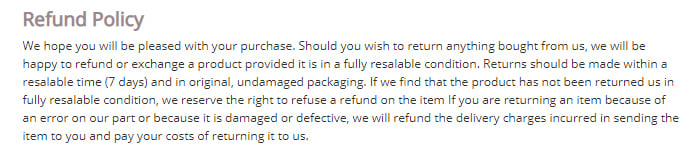
That paragraph is the entirety of the Refund Policy, and it's included towards the end of the overall Terms and Conditions. There's no need to have a full separate page and document for the Refund Policy in this case.
But, for most businesses, your Refund Policy may easily end up being longer than this short paragraph.
What Should Your Refund Policy Contain?
Refund Policies vary from store to store, and area to area depending on local legal requirements. Some policies, for example, are more generous than others. All that matters is that you don't impose terms that restrict a customer's statutory rights under the applicable law. These terms will be unenforceable, which could undermine your entire Refund Policy.
There are, however, some clauses which every comprehensive and legally enforceable Refund Policy should have. To help make things clearer, we'll break the Policy into sections: refunds, exchanges, shipping, initiating the refund or exchange, and cancellation.
Even if you include your Refund Policy as part of your Terms and Conditions, and you don't have a separate Refund Policy, you should still include these clauses or information addressing each point.
Refunds
The simpler your Refund Policy, the better. But it still needs to be informative and address relevant information.
Refundable Items
It's fine to choose to offer refunds on some items but not on others. Common non-returnable items include:
- Jewelry
- Underwear
- Sale items
- Cosmetics
- Food and perishables
- Custom items
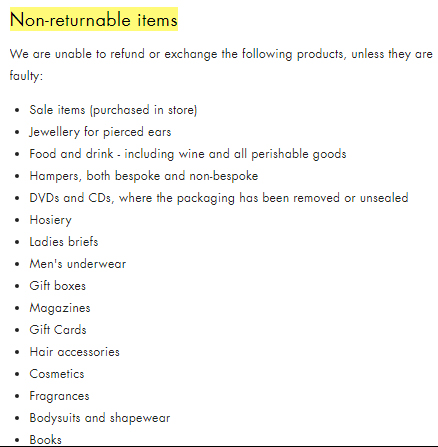
Harvey Nichols set out a clear list of items it won't refund:
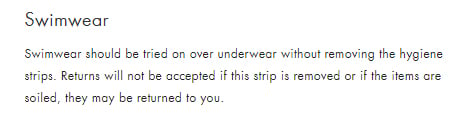
The company will only accept some returns under some conditions. For example, you can only return swimwear if the hygiene strips are still present and intact:
FLEO won't refund sale items:

And some Etsy stores won't refund face masks, due to their personal nature:

Finally, Origin Fitness won't refund custom orders:

You can also refuse to accept returns for used items, or items no longer in their original packaging. Strength Shop won't offer refunds for items that customers have used:

Refund Conditions
Common conditions for refunds include:
- Time limitations
- Liability
- Exceptions for faulty items
Most companies only offer customers a certain length of time to return their items. So long as it's not shorter than statutory regulations allow, you can set whatever time restrictions you wish.